Wednesday, March 2, 2011

Stalking Wild Mustard, aka Rapini

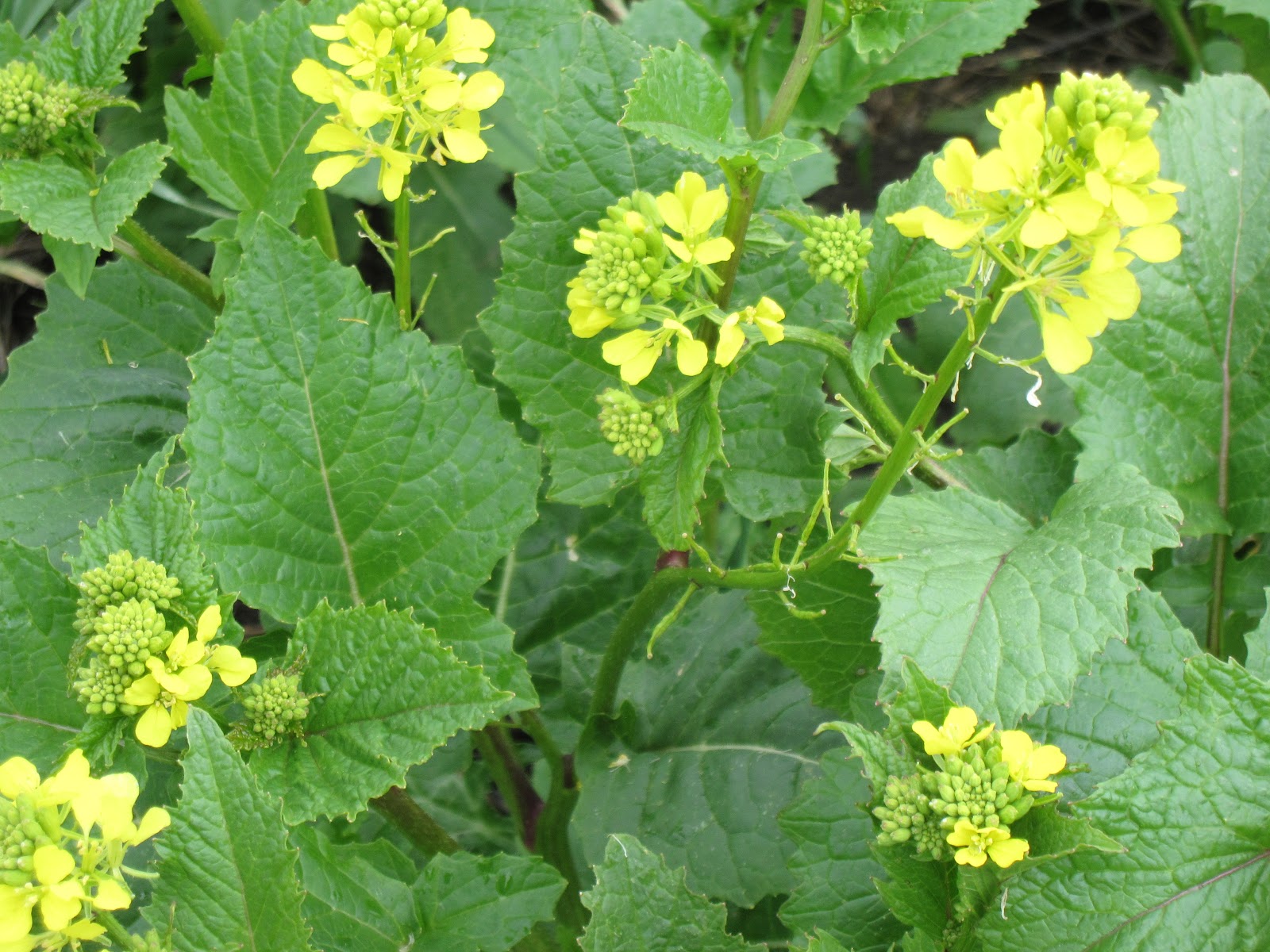
My favorite foraging find yet this season (besides fresh caught Dungeness Crab) has been the delicious, sweet and tender tops of the Wild Mustard plant seen growing all over our East Bay Hills right now.  When "stalking" wild mustard, its important to catch it at the right time, February and March.  Once you see those familiar yellow blooms, it may be too late to collect the unopened flower buds.  I was lucky with this find.  Although mostly a sea of yellow, it was only half in bloom.  I quickly went to work picking the multiple tops of leaves and stalks from each plant. 

Wild Rapini Bouquet

The unopened flower tops of the Wild Mustard plant are similar to Rapini or Broccoli Raab and just as delicious! The leaves, seeds and flower tops from the wild mustard are also edible and delicious.

Also be mindful that another similar plant, Wild Radish sometime grows right next to Wild Mustard.  Wild Radish in CA has purplish white flowers instead of yellow.  Wild radish is also edible, especially the flowers and seed pods but has a stronger taste.


Sea of Wild Mustard in Full Bloom


Mustard Close Up
I go straight for the top sections of leaves and buds.  See the perfect specimen below.  A couple flowers are okay.

Pick this whole part 

There are many ways to cook wild mustard but my favorite is to add a tablespoon or two of olive oil to your pan and heat for a minute.  Add a few crushed garlic cloves and a tablespoon or two of pine nuts and saute for a minute to bring out the flavors and to toast the pine nuts.  Then add the wild mustard tops and saute until they are a bright green color.  Remove from heat and dress with some fresh lemon juice and salt.  These also taste great with a side of fresh avocado.

Into the pan they go


Sauteed with olive oil, garlic and pine nuts - Yum!

So, now can you tell me...How do you "stalk" the Wild Mustard?

Tuesday, March 1, 2011

The bees knees...

It's (basically?) springtime and here in the Bay Area the flowers are in bloom. The bees are a buzzing, and aside from this recent cold snap, we're gearing up for spring. I'm getting ready for planting in the garden, and in the hive, Jamie and I have been waiting for a warm, sunny day to harvest some honey!

With the wet weather we've been having, we have been eagerly anticipating a hive inspection. Last time we went in, there were a couple of moldy comb near the entrance of the hive due to moisture. We cut this away and fortunately, this problem has now been resolved. Whew!

Kim was kind enough (and courageous) to come armed with cameras to help document our adventure and so we began. We laid out all the tools and talked through our order of operations. With hundreds of bees in your face is not a good time to figure out what comes next and who does what... Not to mention, this would be a first honey harvest for both myself and Jamie.


We mainly found brood comb. We cut some of it by mistake because there was so much honey in it! We cut the honey off and placed the brood comb back in the hive and will hope for the best. Because we harvested some brood honey we have placed sugar water near the hive.

By and large the bees were docile. I was prepared for the bees to be angry or to have to cut our session short, but we were able to take the time we needed in the hive. I did feel a little like Godzilla or King Kong at times though...I felt pretty bad...It wasn't until we were done and through and I was walking into the house that an angry bee dive bombed me and I got stung. All those bees and nothing and then twenty minutes later walking through the door and bam! ps. ouch!


Overall, the hive seems to be healthy and is thriving. Viva! It continues to be an amazing experience working with the bees and getting a glimpse into their wild and wonderful world. I expected there to be a lot more honey! We did harvest nearly 2 pints though, and it tastes like bottled sunshine.The honey is just the sweet topper at the end of the day.

Sunday, February 13, 2011

San Francisco Fishing Tour

Need a crash course in San Francisco Fishing?  Kirk Lombard, author of the Monkeyface (Eel) News is your man.  Today he held a wild food workshop through Forage SF on the San Francisco waterfront that went way beyond regular rod and reel fishing.  Attendees learned to poke pole for monkeyface eels, toss a Hawaiian casting net, forage for mussels and other shellfish, find bait, identify seaweeds and crab using small traps from a fishing pole.  Even seasoned fishing folks attended and learned something new from Kirk's workshop.

Crab Fishing

Crab fishing was first on the agenda and we immediately retrieved a double header of Dungeness Crabs.  Dungeness aren't legal within the Golden Gate and they were small (less than 5 and 3/4 inches) so they were quickly tossed back.  People fishing for crabs in this location are going for another type known as the rock crab which are difficult to crack but just as delicious as Dungeness.  For more on this type of crabbing, see crabbing at the Pacifica Pier.

A Double Header!
Explaining Bait

Sustainability was also a huge focus of Kirk's workshop.  The Italian side of me was pleased when Kirk suggested eating fish at the bottom of the food chain, such as herring and anchovies.  In an earlier blog, I wrote about a Belize fishing vacation where the bait (feshly netted sardines) was the best fish we ate all week.  Local edible bait fish include Herring, Anchovies and smelt.

Native American Style Smelt Net

The workshop was fast paced and more about passing on information then actual fishing.  Nonetheless, participants were encouraged to fish along side Kirk as long as they had a valid California fishing license.
Hawaiian Casting Net

Finding bait like worms and crabs under rocks
The best part of the workshop was the demonstration on poke poling for monkeyface eels.  I have seen fisherman do this type of fishing in Pacifica during the minus tide and have always wanted to try it.  Eels are plentiful and Kirk explained that without a commercial fishery for them, they are considered a sustainable fish.  Although he didn't catch an eel today, he did catch a small Cabezon and Rock fish.

Poke Poling for Eels
All in all, the workshop was fantastic.  It was very informative and mixed with both men and women.  If you go, bring a pair of shoes you can get wet, warm clothing, and a pad of paper to record Kirks wealth of information.  Now, I'm off to go fishing.

Wednesday, December 15, 2010

Roots to Boot

I love the hearty meals of Winter. In the garden, plants like beets and turnips provide tasty roots and greens alike. How about some mashed Kohlrabi? When I think of winters bounty I think of one word…SQUASH! Butternut, acorn, spaghetti, kabocha -what’s your favorite? Squash will keep for quite awhile… but it is to be savored now. An hour in the oven to cook that squash will make your house toasty warm.

Collards, kale, mustards, chard, and salad greens crank all winter long with practically no watering, thanks to the rain. Of course here in the Bay Area, we can also enjoy these greens all year round. Don’t forget the delicious nutritious broccoli, cauliflower, peas, and Chinese greens like bok choy etc. There are also favas, brussels, and cabbages to come, sauerkraut anyone? And when it comes to soupmaking, there’s always a bunch of carrots and celery stalks for the soup stock awaiting, to help to manage all of those greens!

Alliums galore like onions, leeks, garlic, chives, and other tasty tubers like potatoes, parsnips, burdock, radish, daikon, etc. are also in season. Don’t forget those fruits, as the citrus has been sweet and plentiful, and can we just say persimmons? Yum!

Get it while it’s cold because spring is right around the corner~

Saturday, November 27, 2010

Dungeness Crab Fishing - Pacifica Pier


Kim holding a Rock Crab
Recreational Dungeness Crab fishing opened on November 6th.  It's easy to catch them from the Pacifica Pier in Pacifica, CA just south of San Francisco.  Best yet, you don't need a license to fish from Public Piers in California.  There are at least two different types of crabs you can fish for from the pier, Dungeness and Rock crabs are abundant.  Check the CA fish and game website  for size and take limits and information on crab species in CA.

A Triple Header!

Fishing from the pier can be done with a drop net and bait like fish heads or chicken but the take is usually rock crabs with that method.  Rock crabs are huge and delicious but their shells are hard so they are harder to crack after cooking.  They also have less meat but are worth it to try.  Sea lions also love to attack crabs feeding on drop nets.

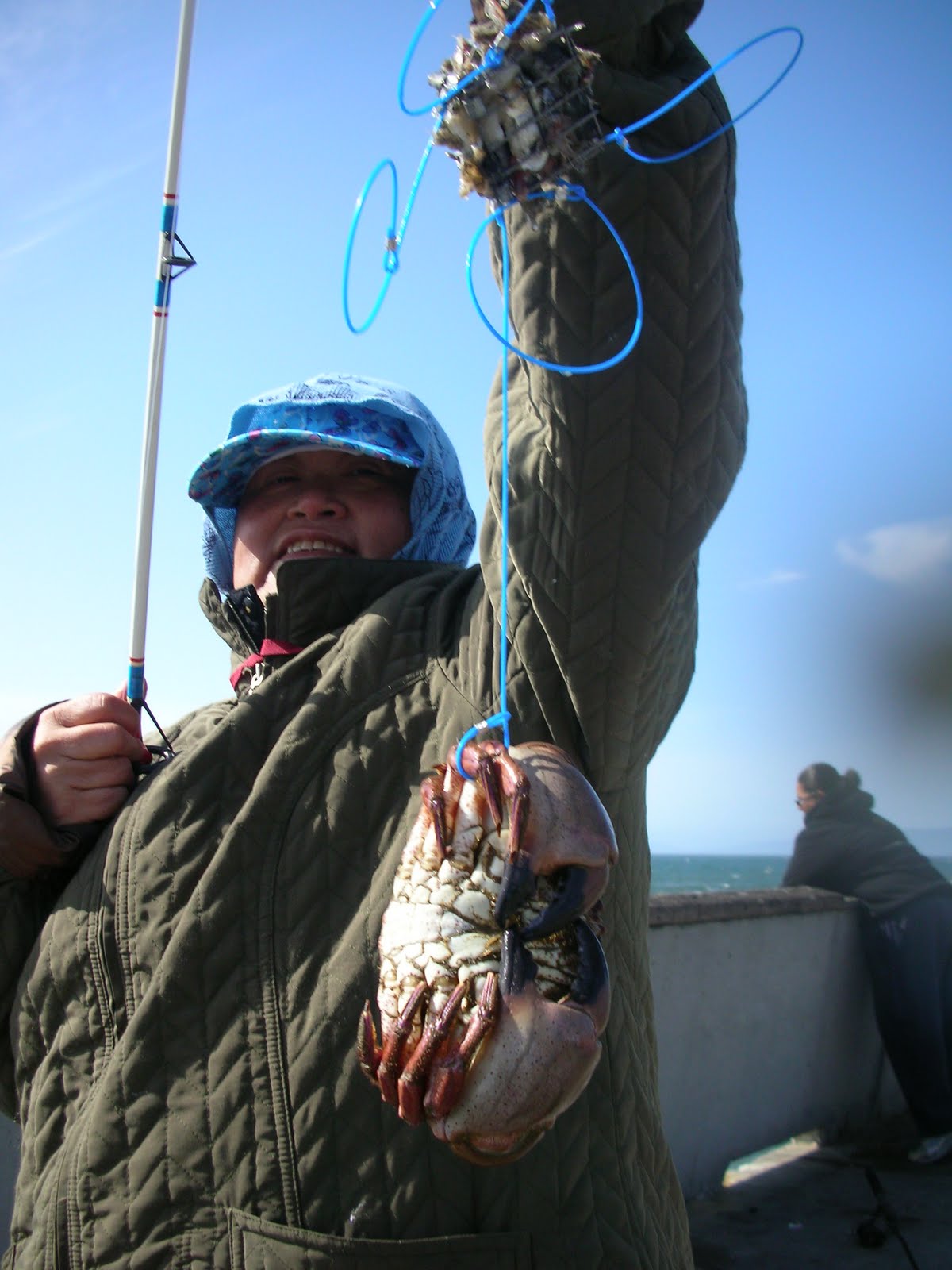
I prefer crab fishing with a large ocean rod and snare baited with a mix of sardines and squid.  Crab snares, bait, tackle, measuring tools and advice can be obtained at the Rusty Hook fishing shop near the pier.  I have found that the best traps are sometimes sold on the pier for around $5.  It helps to put a small 2-3 ounce sinker in the basket before adding bait so as to get a better cast and to keep the trap put on the ocean floor.  Walk to the end of the pier if you can find a spot there.  Toss your snare as far as possible.  Let settle to the bottom and then reel in the slack until the line is taught.   Wait about ten minutes.  Then, reel in very slowly to get rid of any additional slack.  As soon as you feel the weight of the snare, pull the rod tip up hard and fast.  If there is a crab on, it will feel extremely heavy and hard to reel in.  Sometimes if you wait too long, the crabs will pull the traps into the sand.  If that happens just keep trying to free the trap and crabs by pulling up on the rod tip.  Be very careful when releasing crabs from the snare.  Rock crabs bit hard.

My friend Mel and I went fishing on a beautiful Saturday and caught this pile of "Dungies" and Rock crabs.

Rock Crabs and Dungies we caught


The Snare with an unwelcomed guest
Mel with Rock Crab and Snare
Fishing is also popular on the pier.  Kingfish, Jack Smelt, Perch, Striped Bass and even Salmon can be caught from the pier.  Baitfish like Anchovies can also be caught using Sabiki Rigs purchased from the Rusty Hook store.

Jack Smelt
Most important, the pier is beautiful and family friendly.  The view is stunning on sunny days.  Sea lions, and many bird species are common sightings.  One time I even saw a whale swimming in the distance from the end of the pier.  There is a coffee / snack shop called the Chit Chat Cafe with bathrooms conveniently located at the end of the pier.  

Finally, be sure to check the weather before you go.  It can be cold and the sea can be rough on windy days.  Get out there and have fun catching crabs.  The season runs through 6/30/11.

What a View!

A closer look at the huge claws of the Rock Crab

Wednesday, November 3, 2010

Found Fruit Writers in Vogue Magazine

November 2010 Issue

You don't have to be "fashionable" to be in Vogue. Michele Senitzer and Kim DiGiacomo of http://www.foundfruit.com/ got a mention in the November 2010 issue in an article by Hamish Bowles called; "Now, Forager" (Pages 102-106) written following his trip to Oakland to spend a few days with Urban Farmer and author of "Farm City", Novella Carpenter.

As part of their time together, Novella, her partner Billy and Hamish decided to try their hand at fishing for Halibut on the Berkeley Pier.  Michele and I were invited to join the "party".  It was cold, windy and quite frankly a miserable day...too cold for most people to even venture onto the pier, much less fish.  But this was a foraging adventure and gosh darnit, we were committed.  

I think it's fair to say Michele and I really had no idea of the types of articles Hamish writes or that there was a possibility for us to be included in his article.  So imagine our surprise when we got the call that we were mentioned in the November 2010 issue of Vogue?  The article over all was a very realistic description of our beloved gritty city of Oakland and how many of us have returned to urban homesteading, foraging and raising animals for food.  

Nov 2010 Vogue Magazine

I loved Hamish's description of that day on the Berkeley pier as he waxes eloquently about the beauty of San Francisco standing off in the distance and the cold efficient fishing we did.  In spite of the sometimes difficult fishing conditions on our Bay Area piers like Berkeley and my favorite, Pacifica Pier, you can always be wowed by the breathtaking views.  One time while fishing on the end of the Pacifica Pier, I could see whales migrating in the distance.

When Michele and I joined them that day on the pier we realized our friends were a little new to fishing and needed some help to understand the best methods to land Halibut.  For one thing, Halibut are mostly a bottom dwelling fish who prefer live bait.  We cautioned that lures probably weren't going to do the trick.  Overhand casting is also considered a "no no" on most California Piers so we taught them a pretty efficient underhand cast.  We had 4 rods so we set up 2 for Novella and Billy to bottom fish with frozen anchovies.  Then we set up 2 rods to try to catch live bait.  Hamish was on one of the bait rods. Suddenly Hamish felt a tug.  He excitedly reeled in a small fish and what we commonly call a "Bull Head"or Sculpin.  Perfect for live Bait for a Striped Bass.  Hamish asked me to snap a quick photo with his camera and then I took the Bullhead off Hamish's line and placed it onto Novella's line as bait, hoping a big fish would pass by.

Unfortunately nothing else was biting and Novella, Billy and Hamish didn't realize how cold the pier can get.  After putting in a solid effort, they moved on to other adventures hoping Michele and I would catch a huge striped bass for dinner the next night.  Michele and I fished on but no one was catching anything that day other than a cold.

The next day we attended the forage party and "send off" for Hamish at Novella's urban oasis on a vacant lot next to her home in West Oakland.  It was a fun gathering of down to earth fellow foragers.  


The Foraged Spread 

Another point of the gathering was to try a new outdoor earthen oven Novella had built with a friend.  Pizzas were roasting inside when we arrived.  My favorite tasting from the oven was freshly picked zucchini blossoms from the garden lot we were gathered in.  They were filled with feta and fresh basil, dressed in a little olive oil and salt.  Delicioso!

Outdoor oven
Novella and Hamish survey the oven

Homemade Pizza Paddle

Escargot Anyone?
Other interesting forageables included roasted snails (escargot) which cooked a bit too fast in the oven and came out chewy and a bit too salty...I had heard they are the same snails as are eaten in France so I was excited to try them.  These weren't my favorite but I think I will give them another chance soon.  Someone brought homemade cheese and acorn bread that was very good.  Novella's Sangria was nice.

Flower arrangement collected from lot
Vogue Photographer
But the other most amazing new thing we ate were the Persian Mulberries she had growing on the lot. I had mulberries before but never like these. They were sweet and juicy and would make a very very nice wine. We stayed long into the darkness talking and chatting and making new friends.

Tuesday, November 2, 2010

Pickled Eggs - Amish Style

Michele and I were tending to her garden and chickens the other day and realized we had all the ingredients to make a cherished treat from my childhood, Amish style pickled Eggs.  I grew up in rural Pennsylvania on a farm.  We raised chickens and rabbits for food and tended a huge garden.  We supplemented our food with visits to the local Amish markets and that is how we learned to make Amish style pickled eggs.  If you like pickled beets, you will love these eggs.


First step is to boil up some eggs.  There are different methods to ensure the shell comes off perfectly.  I probably violate them all, but found my method works.  Pricking the eggs with a pin before placing in the water helps to keep the shell from cracking. I boil them for about 12 minutes.  Then immediately run cold water over them until all the heat is gone.  Then I let them sit in the water a few minutes to cool down and peel. 

While your eggs are boiling, boil your beets as well until cooked.  Save a 1/2 cup of the beet juice for the recipe below. Once they cool down, peel the skin off the beet. You can slice them or keep them whole. 

Ingredients:

8-10 eggs
12-15 cooked beets
1/2 cup of beet liquid
1/2 cup white or cider vinegar
1/2 cup white or brown sugar
1/2 teaspoon ground cinnamon (This is the secret ingredient. The taste it adds is subtle and amazing.  You can add a whole stick of cinnamon if you really like it)
 
Place all ingredients together in a canning jar and store in your refrigerator.  Eggs may be eaten the next day but are best (pink to the yolk) around day 4.  Eggs will keep for two weeks in your fridge (but they never last that long)
 
Let us know if you try this recipe and your best method for shelling boiled eggs.